 Kenal
KenalKenal Sign
Sign agreements tied to a verified identity.
Kenal Sign links every signature to a customer you have already verified with Kenal eKYC. They confirm with a one-time code to their verified channel, and the document, signer and consent are sealed together. Kenal Sign is in development, and we are inviting a small group of institutions to work with us ahead of general release.
Last updated
What Kenal Sign is
Kenal Sign is a digital signing service in development that ties each signature to an identity verified through Kenal eKYC and a one-time code, sealing the document, signer and consent together.
It is built for institutions with long agreements, remote customers and repeat signings, such as banks and lenders. Verify a customer once, then let them sign again and again with proof of who signed every time.
How it works
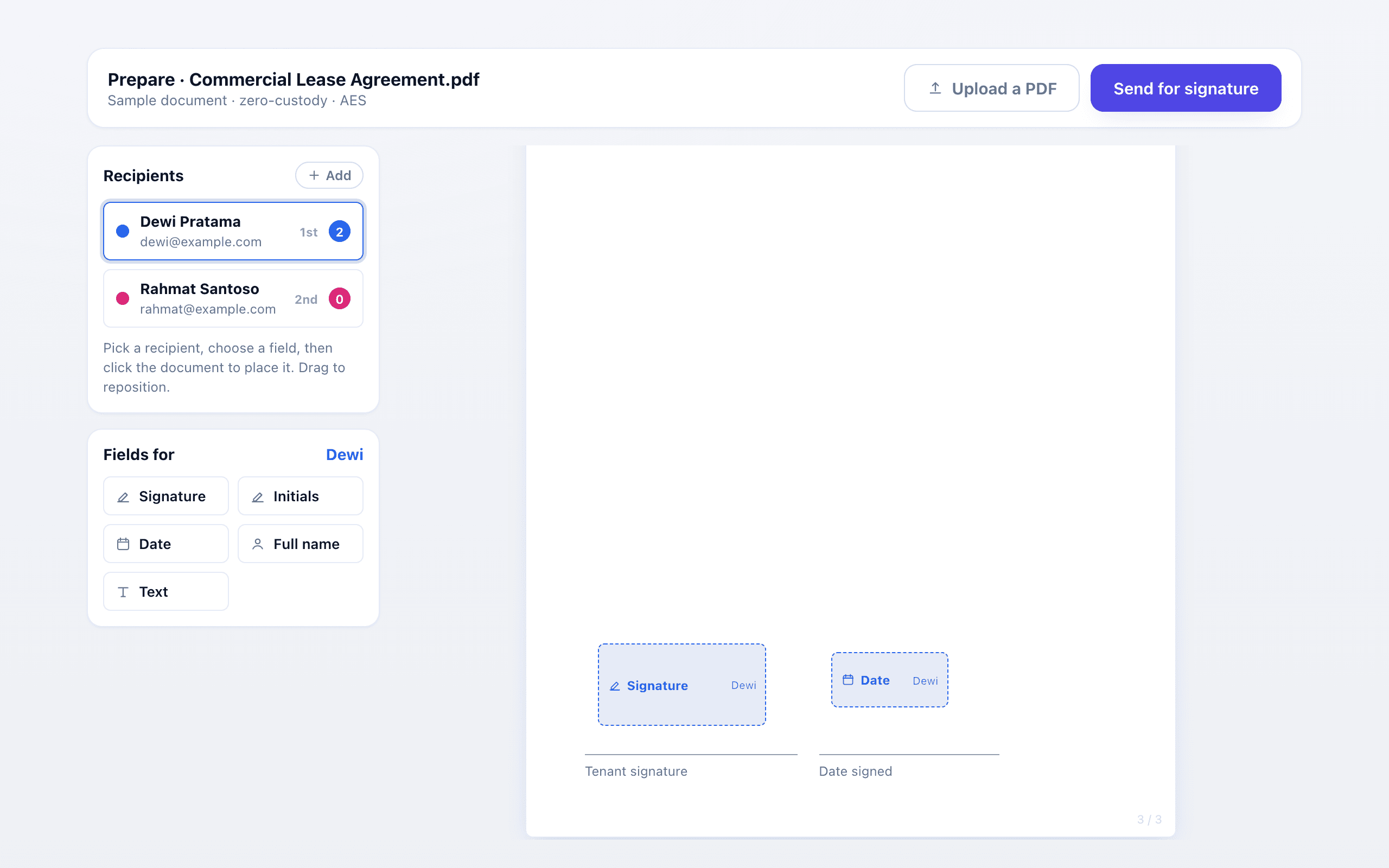
You prepare the document once. Your verified customer signs on their phone in four steps.
Review and sign
The customer opens the document on their phone, reviews it and adopts their signature in the fields you placed.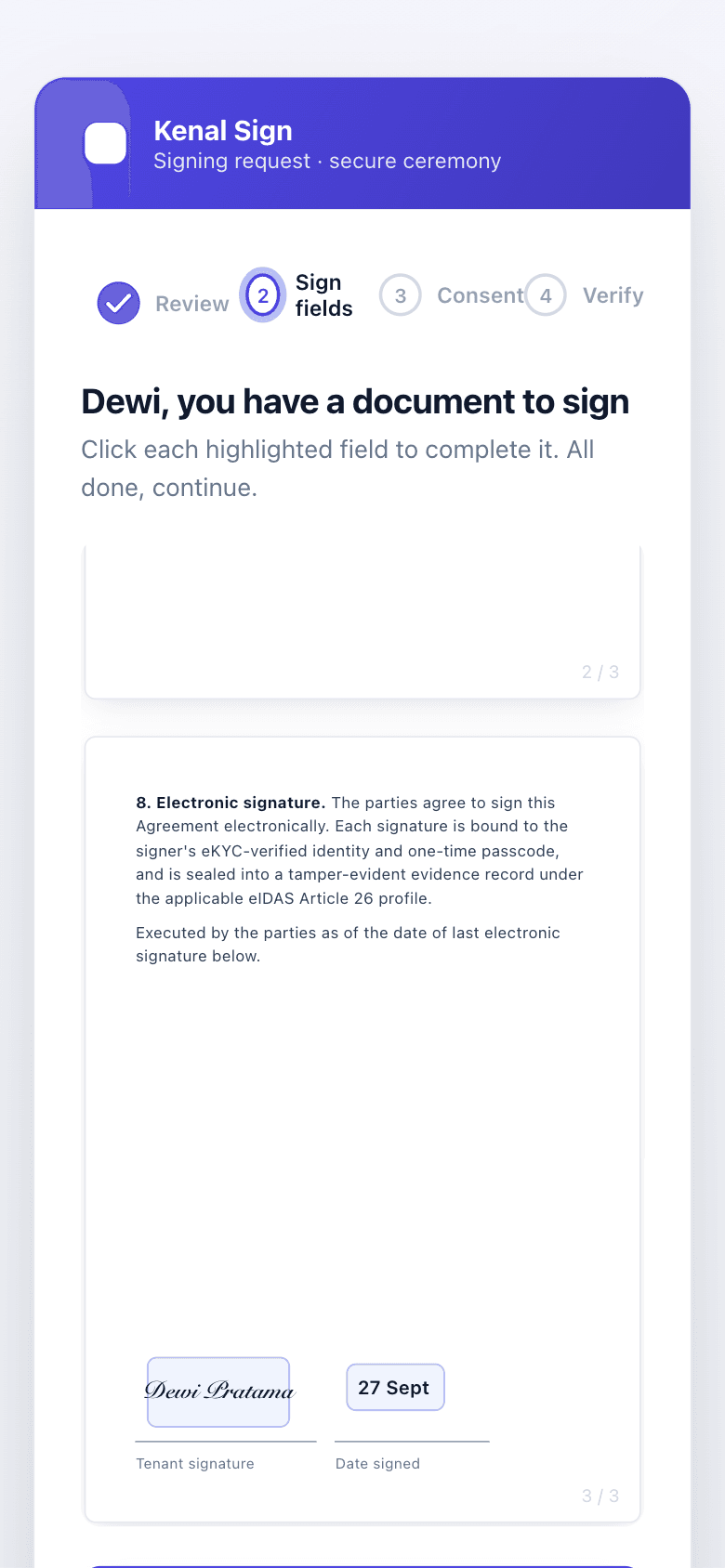
Give explicit consent
They agree to sign electronically. The box is never pre-ticked, and their consent is recorded in the evidence.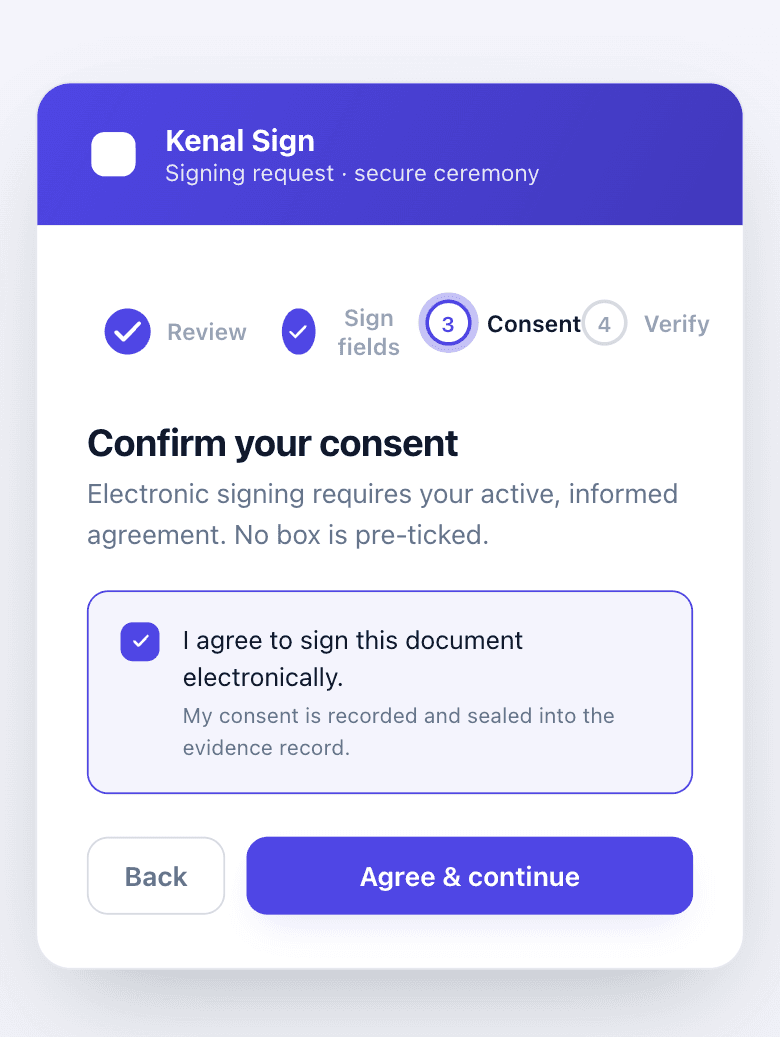
Confirm with a one-time code
A one-time code goes only to the contact channel bound to their Kenal eKYC identity, never to one typed in at signing.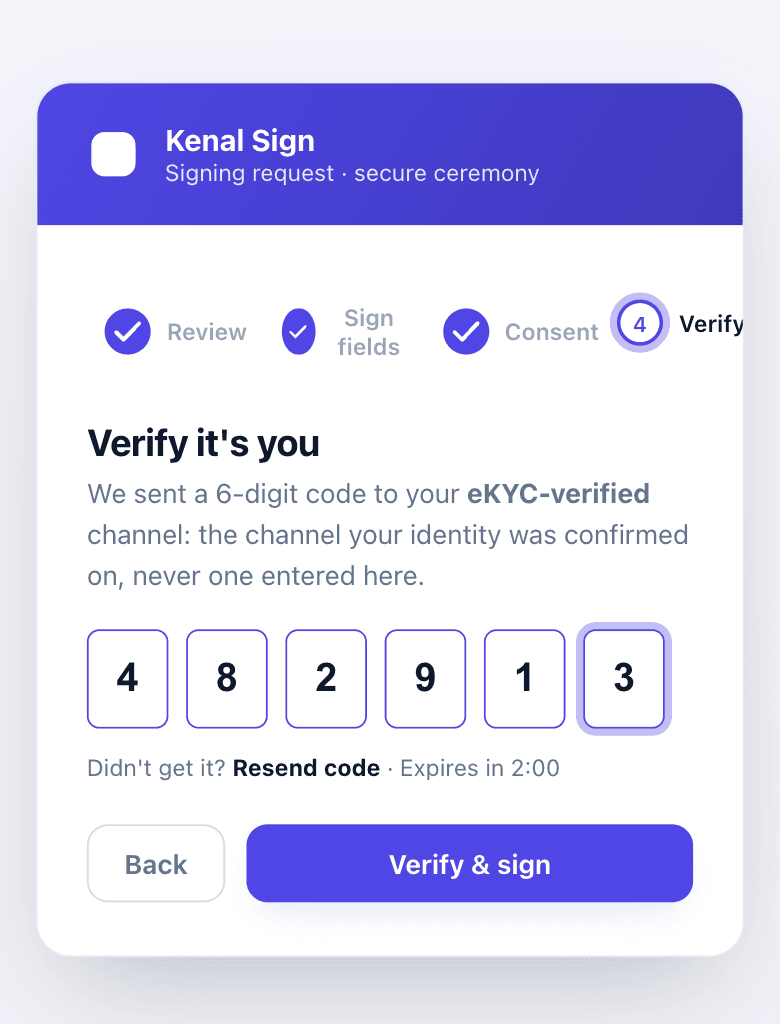
Sealed, with the proof attached
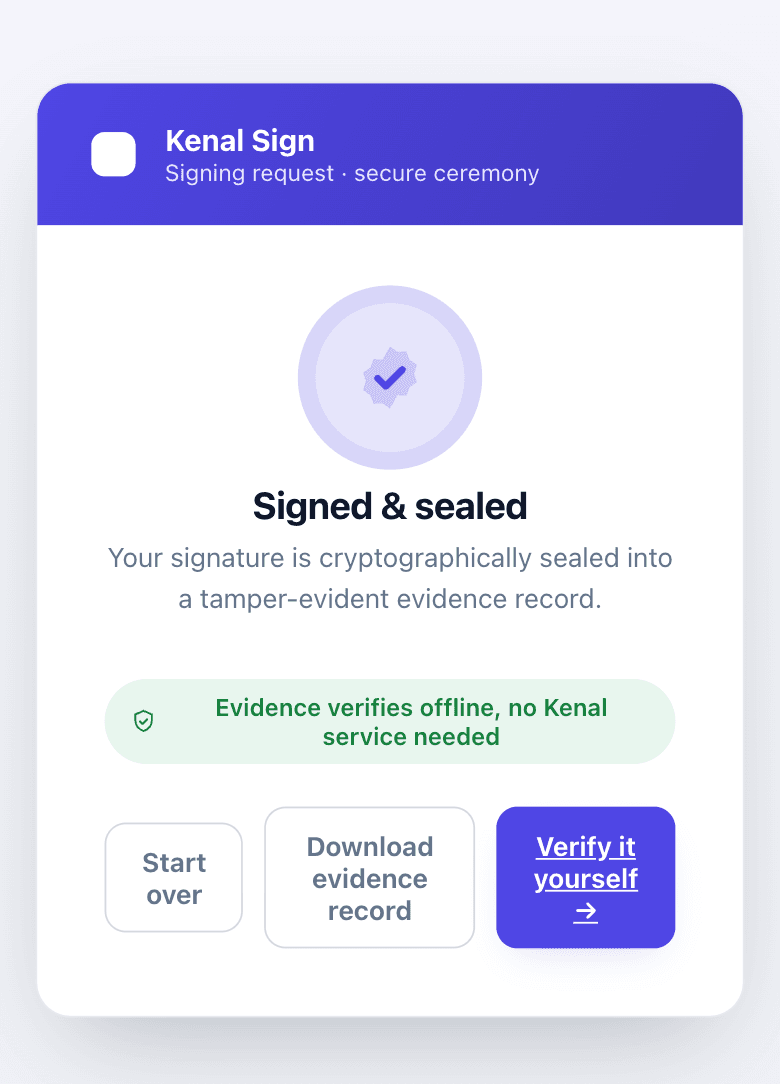
The document, signer, consent and code are sealed into one tamper-evident record with a trusted timestamp, which anyone can verify offline.
What you get
For every signed agreement:
A signature tied to a verified person
Each signer's identity comes from Kenal eKYC, not from an email address alone.
One evidence record
Document, signer, consent and one-time code sealed together with a timestamp.
Tamper evidence
Any change to the document or its audit trail after signing shows up on verification.
Offline verification
Anyone can check a signed document without contacting Kenal.
Compliance and security
Designed so the proof does not depend on trusting us.
- Built to the criteria for an advanced electronic signature: uniquely linked to the signer, identifying them, under their sole control and tamper-evident.
- Explicit consent is captured at every signing and sealed into the evidence record.
- The audit trail is hash-chained, so an inserted, deleted or reordered event is detectable.
- Each institution's data is isolated at the database level.
Questions buyers ask
Is Kenal Sign available today?
Kenal Sign is in development. We are inviting a small group of institutions to work with us ahead of general release. The signing flow, evidence record and offline verification are built and can be demonstrated today. Institutions that join get a working environment for their own agreements, a direct line to the product team and a say in the templates, channels and integrations we prioritise.
How is Kenal Sign different from a typical e-signature?
Kenal Sign ties each signature to a verified person, not just an email address. The signer's identity comes from Kenal eKYC, and the one-time code goes only to the contact channel bound to that verified identity. The document, the signer, their consent and the code are sealed together into one tamper-evident record that shows who signed and that nothing has changed.
Does the customer need to repeat eKYC every time they sign?
No. Customers verify once with Kenal eKYC, and that identity is reused for later signings. At each signing they confirm the document, give consent and enter a one-time code sent to their verified channel. That keeps repeat signings quick for long relationships such as loans and mandates, while every signature still traces back to a verified person.
How can someone check a signed document later?
Anyone holding the signed document can verify it offline, without contacting Kenal. The evidence record travels with the signed PDF, and the verifier checks that the document is unchanged, the seal is valid, the timestamp is intact and the audit trail has not been edited. That matters when an agreement is challenged years after it was signed.
How can we work with you on Kenal Sign?
Talk to our team and tell us what you need signed, by whom and in what volume. We will show you the current build, agree a scope for an early deployment and connect it to Kenal eKYC if you already use it. Kenal Sign suits banks and lenders with long agreements, remote customers and repeat signings.
Used with
Verify with Kenal eKYC, sign with Kenal Sign, then stamp the agreement with Kenal Stamps.
Work with us ahead of release
We are inviting a small group of institutions to work with us ahead of general release. See the current build, scope an early deployment and help decide what we build next.